A corporate video for several markets needs one decision before the shoot: subtitles, voice-over or both. This guide shows when each works, how to prepare interviews, scripts and graphics, and how to get approval in several languages without delays.
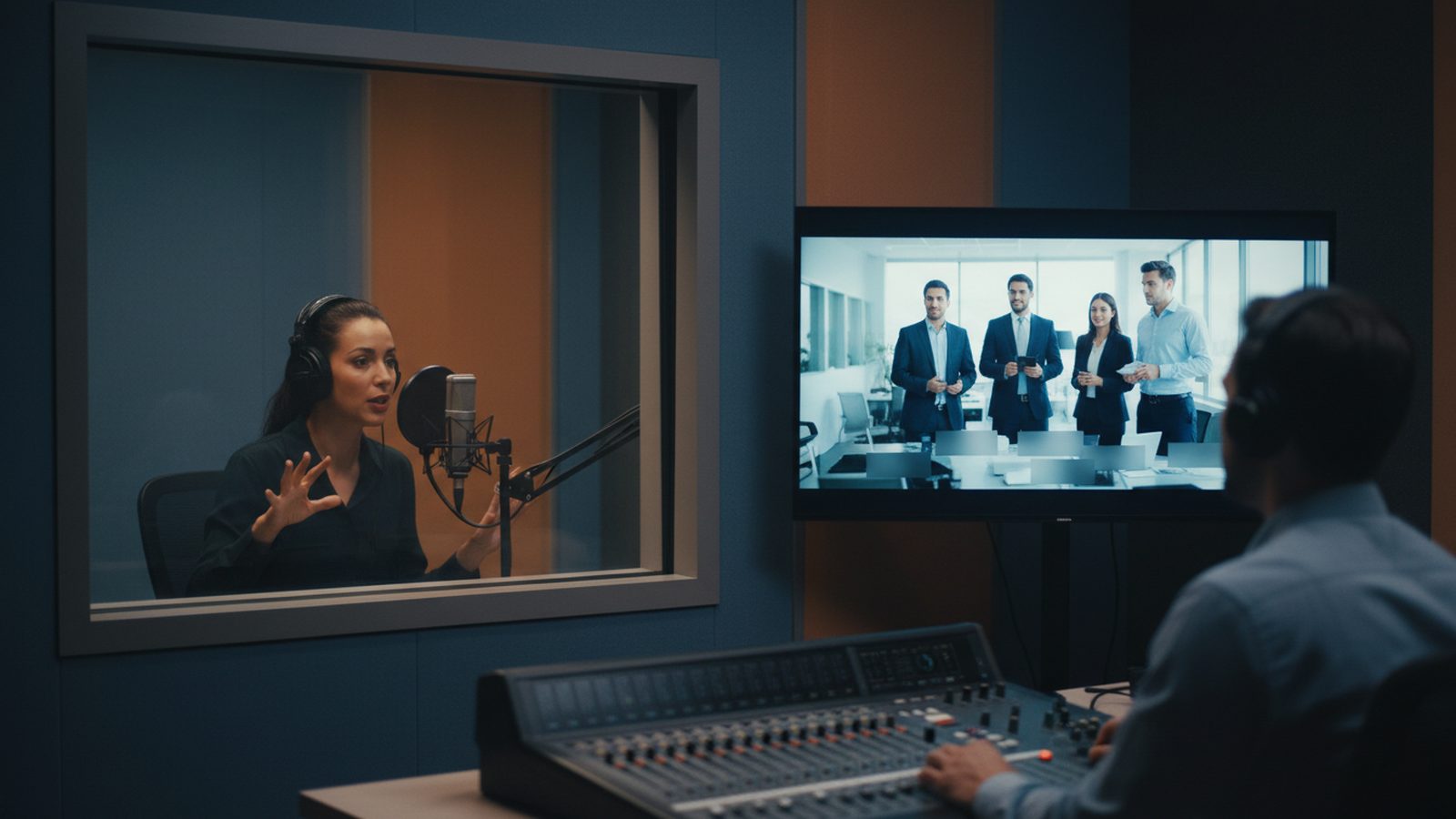
If your company sells in several countries, one film often has to speak to a head office abroad, customers in Germany and distributors in a third market. There are three ways to take a film into another language, and they differ in effect, effort and how easily they can be changed later:
| Method | How it works | Strength | Weakness |
|---|---|---|---|
| Subtitles | Original sound stays, text appears on screen or in a file | Voice and personality stay, changes are easy | Viewers have to read, text covers part of the picture |
| Voice-over | A speaker reads the script in the target language | Pleasant to listen to, no reading needed | Each language needs its own recording and mix |
| Voice-over on interviews | Original voice turned down, translation on top | Understandable without reading | Quickly feels like a news report, personality gets lost |
Which one fits depends mostly on how the film is built. A film carried by interviews takes subtitles better than a voice-over. A film carried by a script translates cleanly into other languages: the script is simply recorded again.
Subtitles come in two forms: burned in, so they are part of the picture, or as a separate file (SRT or WebVTT) that platforms and website players load. Burned-in subtitles are always visible. A file can be corrected without a new export and lets one video carry several languages. For social media, burned in is usually right; for your website and YouTube, the file. Line length, fonts and right-to-left scripts are covered in our guide to multilingual subtitles for show videos; the same rules apply to corporate films.
A good compromise is often a mix: a voice-over carries the structure, interviews stay in the original language with subtitles. Viewers hear in their own language what the company does and still see real people speaking.
Remember that text length changes between languages. A script that fits exactly in English often takes longer in German. Leave some air in the edit rather than re-cutting every language version, and have translations shortened to the spoken length instead of translated word for word.
At Pixer we conduct interviews in English, German, Arabic and Persian and deliver subtitles in these languages. If you need others, raise it in the briefing.
Many errors in multilingual films come not from the translation but from the approval. This order works:
Machine translation is useful as a draft, but unreliable for technical terms and product names. Arabic and Persian add the question of writing direction: editing software that is not set up for right-to-left text shows letters separated or in the wrong order.
At Pixer, subtitles are part of every corporate video package, and the language scope grows with the package (all prices plus VAT; non-EU companies pay no German VAT):
| Package | Languages included |
|---|---|
| Corporate Basic, €1,990 | Subtitles in German or English |
| Corporate Professional, €2,990 | Subtitles in German and English, optional voice-over |
| Corporate Premium, €4,990 | Professional voice-over, subtitles in two languages |
| Brand film, from €9,900 | Professional voice-over in two languages |
Additional languages are available as an add-on and listed in the quote. How to fix languages and formats while planning the film is covered in our guide to planning a corporate video.
Real voices stay. People speaking their strongest language are more convincing.
A structured script can be re-recorded per language, and viewers do not have to read.
Voice-over for the structure, interviews in the original with subtitles.
Names, products and technical terms with the approved spelling in every language.
Lower thirds and text panels built so text can be swapped per language.
Approve the transcript first, then have each version checked by a native speaker.
Subtitles are usually less effort, because no recording and no new mix are needed. A voice-over pays off for films that run for a long time and are listened to rather than read.
Yes, and it is often the best solution. We conduct interviews in English, German, Arabic and Persian; the subtitles take care of the translation.
Not in a readable way. Make one file per language for burned-in subtitles, or one subtitle file per language that viewers choose in the player.
Corporate Basic includes subtitles in German or English, Professional both languages, Premium subtitles in two languages and a professional voice-over. Further languages are available as an add-on.
Ideally a native speaker who knows your products, for example from your sales team or a partner in the target market. They spot wrong technical terms faster than anyone else.
Yes, if the film is built for it: subtitles as a file, graphics without fixed text, speech separate from music and effects. That is why the language question belongs in the briefing, not at the end of the edit.
Tell us your markets, the languages you need and where the film will run. You receive a fixed quote within 24 hours, based on our corporate packages.
We reply within 24 hours. For short-notice requests, WhatsApp is fastest.