Anyone speaking on your camera hands over their face, voice and words. Clear consent protects both sides. Here is what the form must cover, a template to adapt and the routine on the stand. Practical guidance, not legal advice.
All prices plus VAT · delivered within 24 hours · See all packages & details
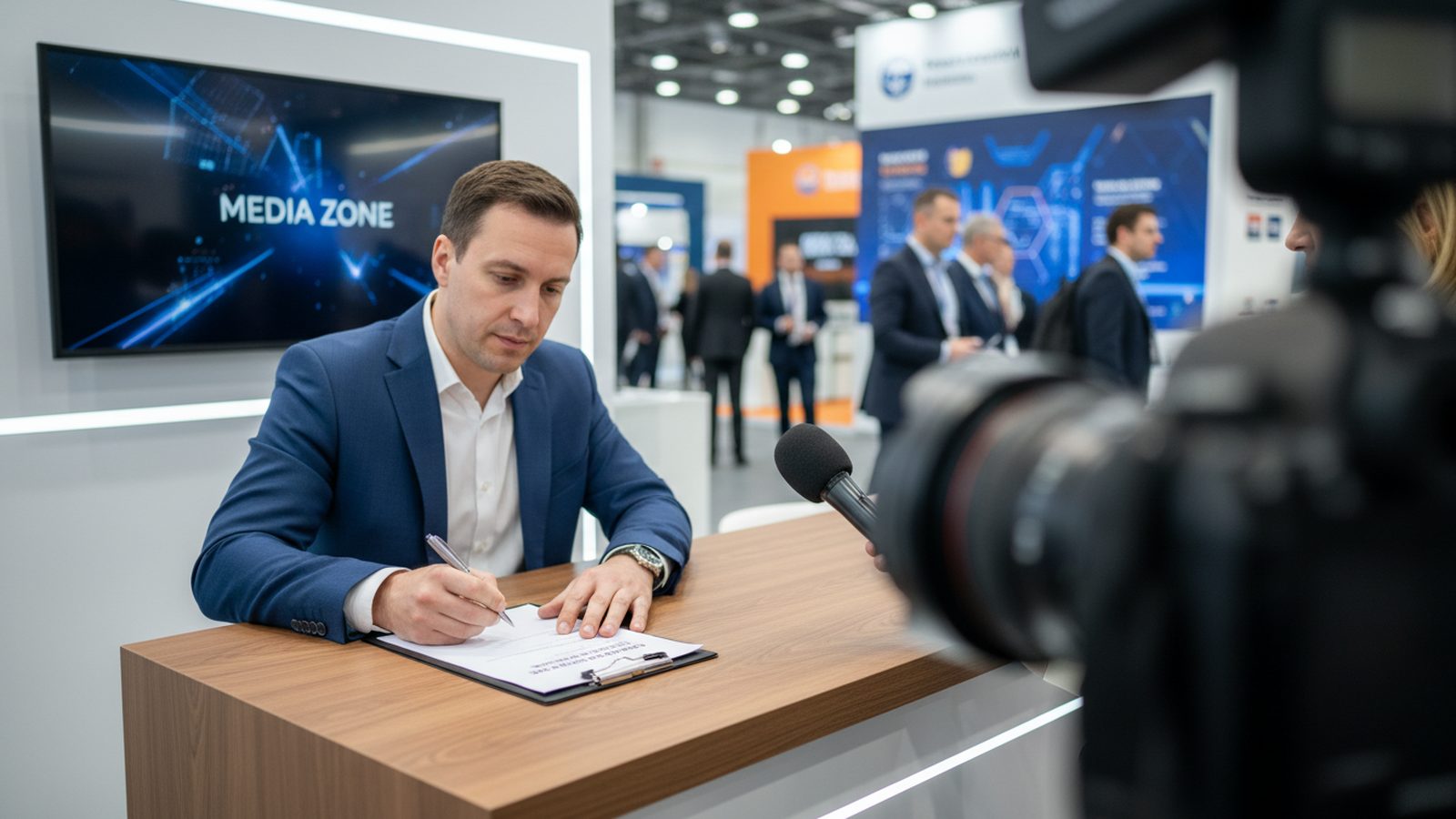
An interview is more than a photo. The person is on screen for a long time and in close-up, their voice can be heard, and they say something that will be linked to their name and often to their employer. The recording is edited, subtitled and used on several channels for months, sometimes in several countries. Do not rely on legitimate interest alone here. The safe route is written consent. The background is explained in our guide to image rights at trade fairs.
This matters most for people who are not your employees: customers, distributors, partners, trade visitors. If questions come up later, they have no reason to be generous. Clear consent answers the questions before anyone asks them.
This guide is practical guidance, not legal advice. The template below is a starting point that your legal team or data protection officer should adapt to your company. If your head office is outside the EU, involve whoever handles data protection for your European activities.
If a fee or anything in return has been agreed, include it in the form. For minors, parents or guardians sign.
The wording below is deliberately simple. Adjust the parts in square brackets and have the text checked before you use it.
Consent to video, audio and photo recording
I agree that [company, address] may record an interview with me in picture and sound on [date] at [name of trade fair] and take photos of me. The recordings may be shortened, edited, subtitled and translated, and shown with my name, job title and company.
The recordings may be used for the following purposes: [website, social media channels, show film, presentations, newsletters, advertising] in [countries or regions, if relevant]. Use is permitted [without time limit / until date].
My participation is voluntary. I can withdraw this consent at any time with effect for the future by email to [address]. Content already published will then be removed where possible. Information on data protection: [link].
Name, job title, company, place, date, signature
For customer interviews, check early whether the person needs approval from their employer to speak publicly about you as a supplier. Otherwise the best line in the film may fail at the approval stage. For questions and sound on your stand (booth), see our guide to on-stand interviews.
Show customers and partners the finished edit before publication. It takes a day and avoids trouble. Pay special attention to subtitles: a translation has to keep the meaning, and names, job titles and product names have to be spelled correctly.
If consent is withdrawn, it applies to the future. You can no longer publish new material with that person, and you should review existing posts and pages and adjust them where possible. What has already been printed and distributed usually cannot be recalled. In films with several speakers, it helps to build the edit so that one person can be taken out.
Keep the consent forms for as long as you use the recordings, and link them to the project in your archive. Anyone who wants to reuse a clip in two years' time needs to see what it is cleared for.
At Pixer we conduct interviews in English, German, Arabic and Persian. Send us your form in advance and we will check before each recording that the signature is there. More on short customer statements on our testimonial video page. And once more: this is not legal advice, and the template does not replace a check by a professional.
For interviews, written consent is the safe route.
Name channels, regions, editing, subtitles, duration and withdrawal clearly.
Send the form with the interview request so questions are settled before the show.
At least English and German, other languages where needed.
Customers and partners see the edit before it is published.
File the consent with the project for as long as the footage is used.
It is better than nothing and useful additional evidence. For use in marketing and advertising, written consent is the safe route.
Yes, written consent makes sense for employees and executives too, ideally on the same form you use for show photos.
Withdrawal applies to the future. You stop using the interview in new material and review existing publications. Edits from which one person can be removed make this easier.
One the person understands confidently. English and German cover many cases. For interviewees from other countries, a translation checked by your legal team is worth the effort.
It is a starting point, not a checked legal document. Have your legal team or data protection officer adapt it to your company.
The company using the recordings is responsible. The videographer can still ask before each recording whether the signature is there and remind you if it is missing.
Planning interviews with customers or partners at the show? Tell us the fair, the dates and the languages, and we will agree the routine and the consent process with you.
We reply within 24 hours. During a show week, WhatsApp is fastest.