A good giveaway makes people stop. A well planned photo moment also gives you pictures and clips for weeks after the show. This guide shows how to combine the two, what tends to go wrong and how to time an activation for the camera.
All prices plus VAT · delivered within 24 hours · See all packages & details
Many exhibitors order giveaways because everyone has them. Pens, tote bags, sweets. The result is familiar: people grab something as they walk past your stand (booth) without saying a word, and by the end of day two the box is empty. A giveaway has only one job, which is to give someone a reason to stop and start a conversation.
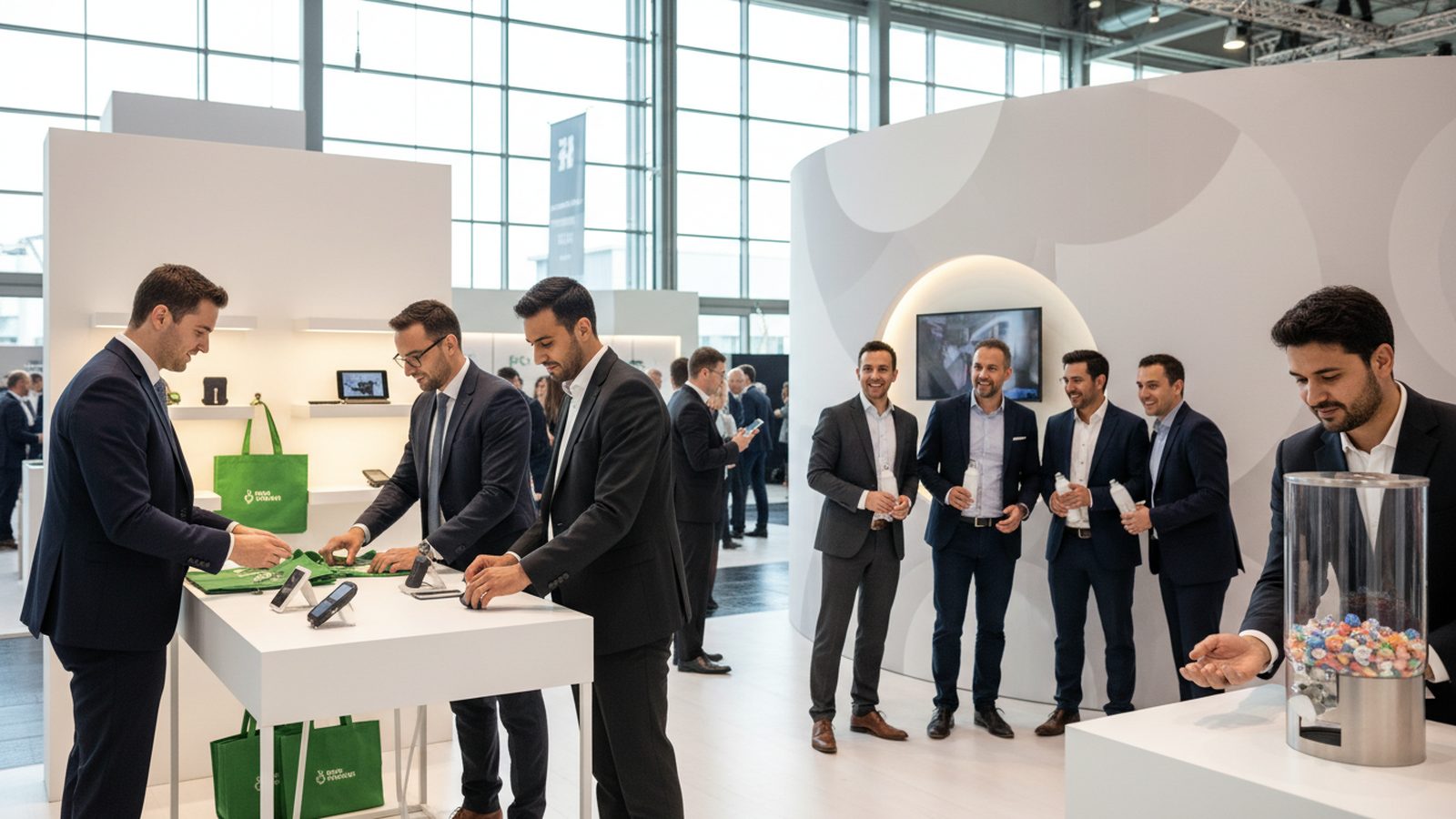
A photo moment has a second job. It creates pictures that visitors share themselves, and scenes your photographer and videographer can capture. A coffee bar that pours your logo into the milk foam, live engraving, a product people are allowed to pick up and try: these are the situations in which people smile, lean in and ask questions. Those gestures are what make trade fair photos feel alive rather than staged.
So plan both together, in this order: first the goal of the show, then the activation, then the giveaway as the natural end of a conversation. If your goals are still vague, start with setting trade fair goals.
A giveaway works when it relates to what you sell and when it is handed over in a conversation rather than left out for anyone to take. These questions help you choose:
The most common mistake is placing giveaways openly on the counter facing the aisle. That attracts collectors, not prospects. Keep the box behind the counter and hand the item over at the end of a conversation. For the camera, that handover is a far better moment than a table covered in merchandise.
Higher-value gifts for selected contacts should stay out of sight, in the storage room or a drawer, so they do not cause awkward discussions on the stand.
If you are shipping giveaways from outside the EU, allow for customs and freight time. Ordering locally or sending goods with your stand builder is often simpler than carrying boxes through the airport.
Not every activation photographs well. What works is anything that puts hands, faces and your product into one frame. These have proven themselves:
Whether music, microphones, tastings or activities in the aisle are allowed varies from organiser to organiser. Read the exhibitor manual before ordering anything. At consumer shows such as SPIEL in Essen, hands-on activations are part of the concept anyway, while at pure trade shows quieter, product-focused activations usually come across as more credible.
The best activation is wasted if your photographer is at the other end of the hall taking the team photo when it happens. Set fixed times and share them in advance. At Pixer we write demos, tastings and prize draws into the shot list and plan the rest of the coverage around them.
How to turn this into a list of motifs is covered in creating a trade fair shot list. With fixed times and a clear list, a photographer can cover several activations properly within a two-hour booking.
Photo moments put visitors at the centre, not your team. That is good for the pictures, and it also means you need a clean basis for how you use them later. A single recognisable person testing a product is a different matter from a crowd in the background.
What works in practice is a short, friendly sign at the activation saying that photos are being taken, plus a quick word before someone becomes the main subject of a picture. People who do not want to be photographed are not photographed, and frames where someone clearly objects are removed. For images you plan to use in paid advertising, get written consent. The details are in our guide to image rights at trade fairs.
Do not leave them on the counter by the aisle. Handing them over at the end of a talk brings prospects rather than collectors.
The strongest photo moments show people touching, trying or personalising your product.
Two or three set slots per day can be documented reliably on photo and video.
Music, tastings, prize draws and aisle activities are regulated differently by each organiser.
Personalisation and demos work particularly well as short 9:16 clips.
Recognisable visitors at the centre of a picture need a clean basis before the image goes into an advert.
Small, light items connected to your product that fit in hand luggage. Samples, test kits or a useful tool from your industry get taken home and used far more often than bulky promotional items.
Two or three fixed slots per day are usually enough. Your team needs the time in between for conversations. A continuous activity without a high point is harder to photograph and tires the stand staff.
That depends on the organiser. Volume, serving drinks, tastings and activities in the aisle are covered in the exhibitor manual. Check it before you order equipment or goods.
Yes, as long as the activation times are fixed in advance. We shoot the empty stand before the hall opens, conversation photos in the morning and the activation at its set time. That fits into the Basic package with two hours.
Then they are not photographed. We remove frames in which someone clearly objects. For images that will run in advertising, written consent is the safe route.
Planning an activation and want it properly documented? Send us the show, your stand number and the activation times, and we will come back with a suggested schedule.
We reply within 24 hours. During a show week, WhatsApp is fastest.