Almost every trade fair photo has people in it: your team, visitors, customers, passers-by. This guide explains in plain language when legitimate interest is enough, when you need consent and how to stay transparent on the stand. Practical guidance, not legal advice.
All prices plus VAT · delivered within 24 hours · See all packages & details
A trade fair stand is open to everyone, but nobody walks past it expecting to end up in your advertising. As soon as a person can be recognised in a photo or video, the image counts as personal data under European law. Using it for marketing needs a legal basis, and the people shown have to be told what happens with it.
If you exhibit in Germany, three layers apply at the same time:
Lawyers still debate exactly how the GDPR and the KUG interact. The practical answer is to plan so that both are satisfied. If your company is based in China, the Gulf, Pakistan or the US, the safe working assumption is that these rules still apply, because the people in your pictures were photographed in Germany. This guide is practical guidance, not legal advice. For binding answers, ask your legal team, your data protection officer or a lawyer.
For trade fair photos, two legal bases matter in day-to-day practice.
Your company has an understandable interest in documenting its presence at the show and reporting on it. That interest is weighed against the interests of the person in the picture. The balance tends to work in your favour when people appear in the background, when the situation is obvious to everyone (a visible photographer, a notice on the stand) and when the use fits the occasion, such as a show review on your website. It gets harder the more one individual is the focus and the more the use looks like advertising.
Consent has to be voluntary, informed, given for a specific purpose and provable. It can be withdrawn at any time with effect for the future. For close-ups, interviews and anything that ends up in an ad or on a poster, it is the safe route.
| Situation | Usual basis in practice |
|---|---|
| Wide shot of the stand with visitors, nobody in focus | Legitimate interest plus a notice on the stand |
| Conversation photo, visitor seen from behind or the side | Legitimate interest, ask briefly if in doubt |
| Close-up of a visitor, face clearly visible | Consent |
| Interview or testimonial | Written consent |
| Image for an ad, a poster or a catalogue cover | Written consent |
Visitors come to your stand (booth) for the products, not for your camera. Good show photos still need people in them, because an empty stand quickly looks deserted in pictures. The answer is usually in the framing:
Watch for signals. Someone who turns away, raises a hand or covers their badge does not want to be photographed, and those frames are dropped. At Pixer we ask before any close-up, and anyone who says no is not photographed. For natural conversation pictures, see our guide to conversation photos on the stand.
Your own team is in the foreground of most show photos. Employees are a special case: because of the employment relationship, their consent has to be genuinely voluntary, and nobody may be disadvantaged for saying no. Collect consent in writing before the show and describe specifically where the pictures will be used. Give the form in a language each person reads well, which matters when your stand team comes from head office abroad. The details, including what happens when someone leaves the company, are in our guide to staff in trade fair photos.
Many people on a stand are not your employees: hosts booked through a local agency, interpreters, staff of partner companies, distributors. Ask the agency in advance whether its staff have agreed to photo and video and for which purposes. Ask partners and distributors directly, ideally with the same form your team uses. It saves discussions on the show day and questions from your legal team later.
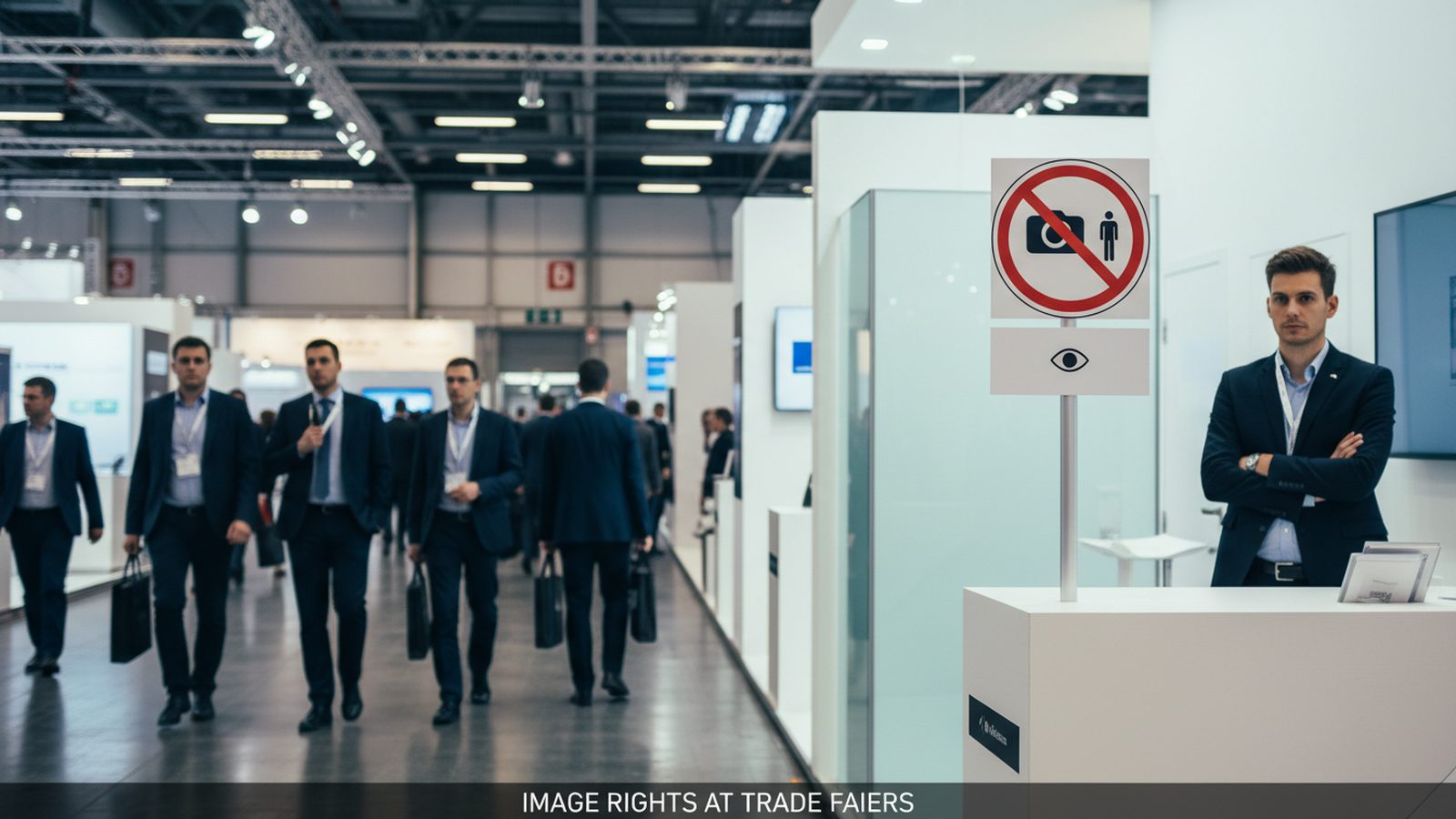
The GDPR requires that people learn who is processing their data and why. On a stand this is straightforward:
If you rely on legitimate interest, people can object. Take that seriously: the image is not published, and images already online are removed or cropped so the person can no longer be recognised. Record the objection, so the picture does not resurface from your archive a year later when someone builds next season's brochure.
Rules on photography on the grounds differ from one organiser to the next. What to check is covered in our guide to photo permission at trade fairs. One more reminder: this text does not replace legal advice. Before a campaign with wide reach, let your legal team take a short look at the image selection.
Legitimate interest for overview shots, consent for close-ups, interviews and advertising.
Wide shots and over-the-shoulder angles instead of faces in close-up. Ask before close-ups.
Voluntary written consent before the show, with the purposes named clearly.
Clearly visible on the stand, with a QR code to your privacy notice.
Anyone who does not want to be in the picture is dropped, in the archive too.
The organiser's exhibitor manual sets the rules for photo and video on the grounds.
For overview shots where nobody is the focus, companies usually rely on their legitimate interest, combined with a notice on the stand. For close-ups and advertising images, get consent. The individual balance decides, so ask your legal team if in doubt.
No. A sign informs; it does not replace consent. It does help you meet the duty to inform and shows that you are open about recording.
The people in your pictures were photographed in Germany. Work on the assumption that German and EU rules apply, and brief your head office accordingly before the material is used in your home market.
Find the images where the person can be recognised, take them out of any publication or crop them, and note the objection in your archive. Reply promptly and keep a record of what you did.
As a rule, the company that publishes the images is responsible for how they are used. The photographer carries out your instructions on the stand, which is why consent questions and no-go shots belong in the briefing.
Planning photos and video for your next show in Germany? Tell us the fair and the dates, and we will agree shots, notices and consent with you in the briefing.
We reply within 24 hours. During a show week, WhatsApp is fastest.