People speak more freely and precisely in their own language. When your customer, engineer or distributor speaks a language the film crew does not, the interview needs an interpreter and a clear routine. Here is how it works on the stand and in the edit.
All prices plus VAT · delivered within 24 hours · See all packages & details
At international shows, people from many countries come together on one stand (booth): your head of engineering from Shenzhen, a key customer from Istanbul, a distributor from Milan. What they say is valuable, but not everyone can say it fluently in English. An interview in a second language then sounds hesitant, and the actual message gets lost.
So the rule is: everyone speaks in the language they are most confident in. The subtitles do the translating later. More on questions, sound and framing in our guide to on-stand interviews.
Pixer conducts interviews itself in English, German, Arabic and Persian. For every other language, such as Chinese, Turkish, Italian, Spanish or Russian, you bring an interpreter. That person becomes a fixed part of the interview team, from the brief to the sign-off of the subtitles. If you are exhibiting in Germany for the first time, our page for international exhibitors in Germany covers the wider picture.
There are three options, each with its own strengths and risks:
Whoever it is, the person must be able to interpret consecutively, sentence by sentence after the answer, and must accept that their voice will usually not be heard in the finished video. They also need a valid pass for the hall. The rules are in the organiser's exhibitor manual.
Before the first interview, plan a short briefing with the interpreter: go through the questions, clarify technical terms, show them their spot next to the camera and agree a hand signal for pauses. Those ten minutes save more time on the stand than they cost.
Simultaneous interpreting, where both people speak at the same time, does not work for video: two voices overlap and can hardly be separated in the edit. On the stand, you work consecutively:
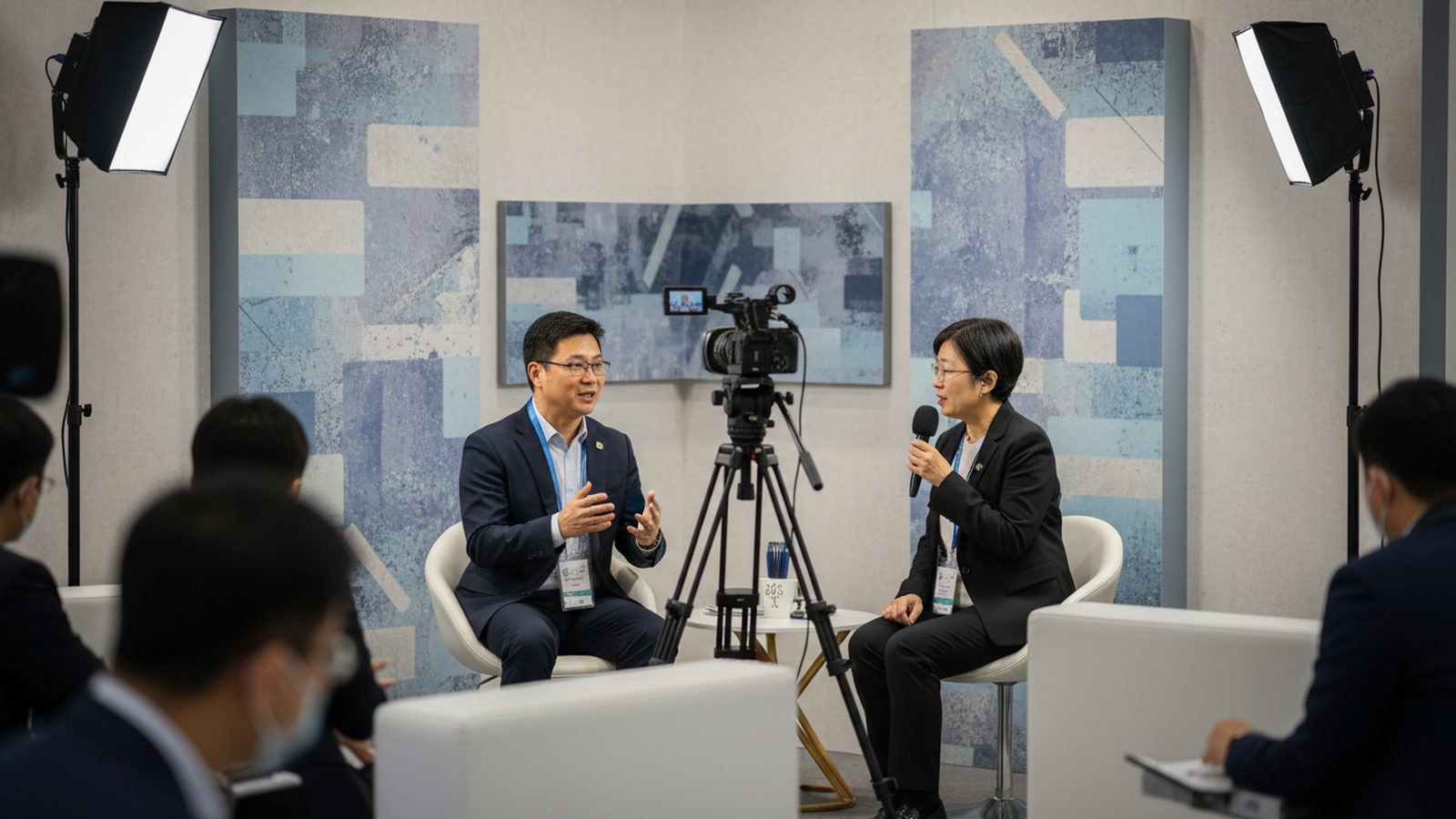
The interpreter stands right next to the camera, at eye level with the interviewer. Otherwise the interviewee looks to the side, and their eye line looks turned away in the video.
In the edit, usually only the original answer remains. For that to work, the voices have to be recorded separately: a clip-on microphone for the interviewee, a second microphone or the camera microphone for the questions and the translation. Nobody should speak into the answer, not even with a word of agreement.
Plan more time than for a normal interview. Every question and every answer is spoken twice, plus follow-up questions. Where a quarter of an hour per person is normally enough, allow roughly double, and schedule the interview for a quieter time of day, early in the morning or late in the afternoon.
The interpreter's short summary on the stand is not good enough for subtitles. It is freely worded and often shorter than the answer. Clean subtitles need three steps:
For languages other than English, German, Arabic and Persian, the translation of the answers comes from your side, ideally from the interpreter who was at the interview. We then set the subtitles in the edit, and the two revision rounds leave room to adjust wording, names and technical terms. Send names, job titles and product names in writing beforehand, in the original script and in Latin transliteration.
Whether subtitles or a voice-over work better depends on where the video will be used. On social media, subtitles are standard; for presentations, a voice-over can make sense. For several markets at once, see our guide to multilingual subtitles for show videos.
The interviewee has to understand the consent to recording and use. Give them the form in their language, or have the interpreter explain it on site. A template and practical notes are in our guide to consent for on-stand interviews.
Before the show, tick off this list:
Everyone speaks the language they are most confident in.
Our team covers these languages itself. For any other language, you bring an interpreter.
Sentence by sentence after the answer, never at the same time as the recording.
Clip-on microphone for the answer, a separate microphone for questions and translation.
Every question and every answer is spoken twice.
Transcript, translation and a check by someone who speaks both languages.
In English, German, Arabic and Persian, and we also deliver subtitles in these languages. For other languages, you bring an interpreter.
Usually not. The edit keeps the original answer, and the translation appears as subtitles. A voice-over is possible if the video is meant for presentations, for example.
Not for video, because the voices overlap. Consecutive interpreting after each answer can be edited cleanly.
Someone from your side who speaks both languages, ideally the interpreter. Two revision rounds are included.
Yes, they have to get into the hall like any team member. How exhibitor or service passes are issued is set out in the organiser's exhibitor manual.
Yes, that works well if they know the questions in advance and have agreed them with the crew. The interviewee then talks directly to one person in their own language, while the crew looks after picture and sound.
Planning interviews with customers or partners from other countries? Tell us the show, the date and the languages, and we will plan the routine and time slots with you and your interpreter.
We reply within 24 hours. During a show week, WhatsApp is fastest.