Most people do not enjoy standing in front of a camera, and it shows when the preparation is wrong. This guide covers whom to choose, how to prepare colleagues and how to run an interview in which nobody reads from a script.
All prices plus VAT · delivered within 24 hours · See all packages & details
Viewers quickly notice whether someone is talking about their own work or reciting a text. A shift supervisor explaining how she organises the handover is more credible than any presenter, even if she searches for the right word once. For candidates this matters twice over: they want to see who they would be working with.
Coming across naturally does not mean everything happens spontaneously. It means preparation and interview are set up so people can speak freely. That takes three things: the right choice of people, preparation without a script, and an interview that feels like a conversation.
For a recruiting video, the people on camera should also do the jobs you are hiring for. More on that in image film or recruiting video.
The most common well-meant idea is a text to memorise. The result usually looks stiff, because the person is thinking about the next sentence instead of what they want to say. Better:
The organisational side, from rooms to schedules, is covered in preparing a shoot day at your company.
How an interview feels depends above all on the person asking the questions. These rules work in practice:
Behzad Heidari, founder of Pixer, has conducted interviews for film and television for more than 20 years. His experience: the best sentences rarely come in the first five minutes, but once the camera has been forgotten.
Besides the interviews, every film needs pictures of people simply working. The same applies there: the less staged, the better.
With two cameras on interviews, as in the Corporate Professional package and above, answers can be shortened in the edit without it showing. That takes the pressure off interviewees, who do not have to deliver everything perfectly in one take. Packages and an example are on our recruiting video page.
Every recognisable person in the film should give short written consent: what the film is used for, in which channels and for how long. Our crew brings the template to the shoot. Show interviewees the preview before publication. It builds trust, and colleagues volunteer more easily for the next shoot.
If someone leaves the company, the film remains usable as far as their consent covers it, and a version without that person can be cut later on request. So plan scenes in the concept that work without individual people, and the film will not depend on one face.
People who want to take part and do the work themselves beat any job title.
Questions a week ahead, without sample answers. Keywords, not sentences.
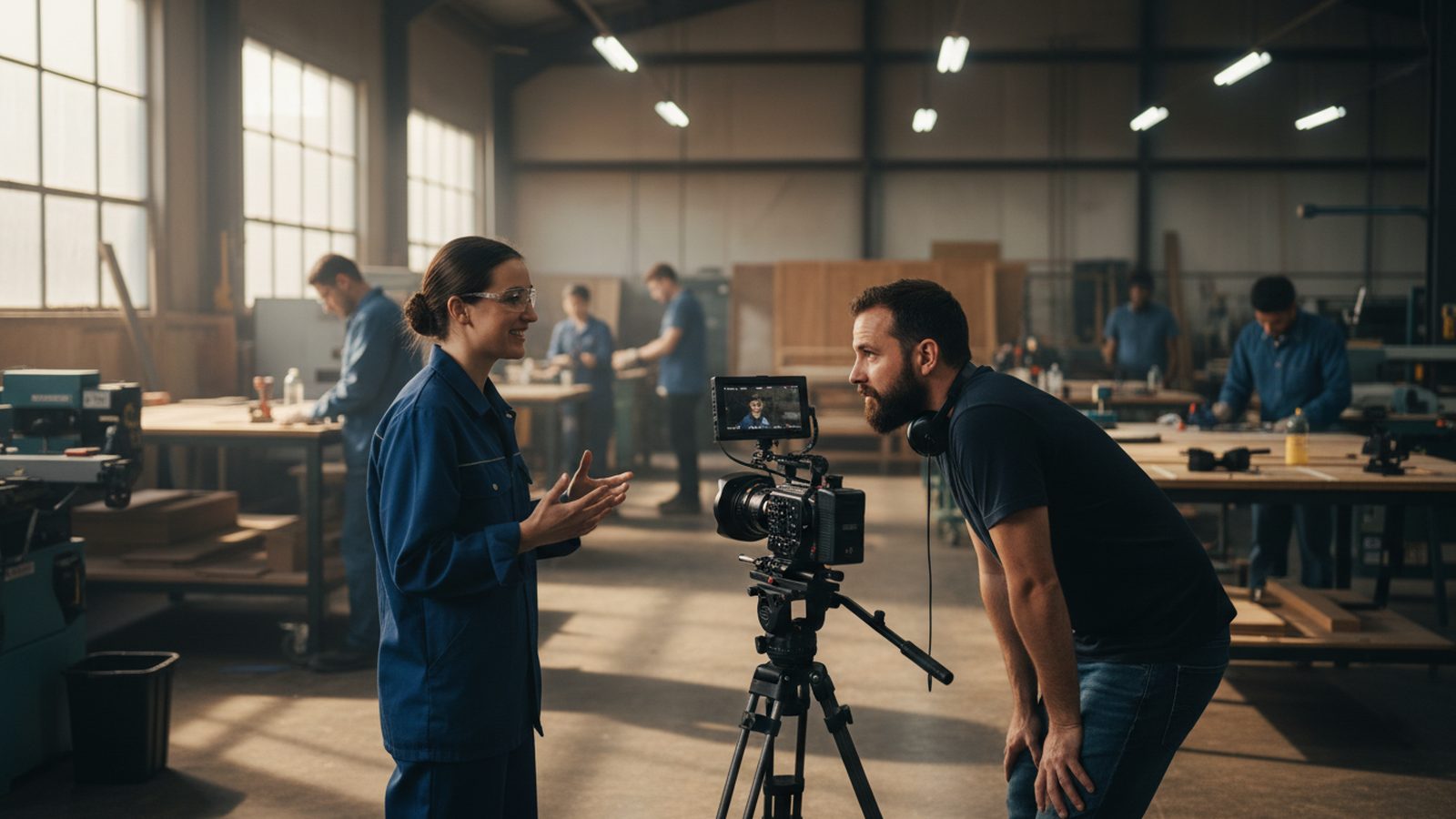
The interviewer sits beside the camera; nobody looks into the lens.
Nothing has to work the first time. Two cameras hide the cuts.
Footage while work goes on, without poses or waving.
Written consent before the shoot, a preview before publication.
Start with a small group and explain what the film is for. Colleagues often volunteer once they hear that nobody reads a script and everything can be repeated. Footage at work is unproblematic for most people anyway.
No. Memorised lines sound stiff. Knowing the questions in advance is enough.
30 to 45 minutes including microphone and warm-up. A few sentences of that usually make the film.
Yes. We interview in English, German, Arabic and Persian and deliver subtitles, so the film works for every viewer, at your German site and at head office.
Preferably not. Managers watching make interviewees more careful. Management sees the preview instead.
Your usage rights to the film are unlimited; the consent governs the use of the person. On request we cut a version without them.
Want to put your team in front of the camera? Tell us the site, a preferred date and how many colleagues should speak. We work out the questions and the schedule with you.
We reply within 24 hours. At short notice, WhatsApp is fastest.