At a first trade fair everything feels equally urgent. This guide sorts the decisions by order and impact: choosing the fair, the stand, the team, leads and documentation, plus the mistakes first-time exhibitors make most often, especially when exhibiting abroad.
All prices plus VAT · delivered within 24 hours · See all packages & details
The most important decision is made before you book a single square metre: at which fair will you meet the people who buy from you, order from you or distribute for you? A large leading fair brings reach, but also competition for attention. A smaller specialist show often brings fewer visitors but more targeted conversations. Look at the exhibitor list and hall plan of the last edition. Are your competitors there, your target customers, your potential distributors?
Then set one main goal: leads for sales, distributors for a new country, a product launch, recruiting, or visibility with press and associations. Each goal needs a different stand, different people and different material. The guide Setting trade fair goals shows how to make them measurable. For dates in Germany and beyond, see the trade fair calendar.
For a first show, a small, well-made stand (booth) almost always beats a large, half-empty one. Stand types mainly differ in the number of open sides:
| Stand type | Open sides | Good for |
|---|---|---|
| Row stand | 1 | Getting started, one clear message, small team |
| Corner stand | 2 | More visibility from two aisles |
| Peninsula (end) stand | 3 | Products that work from several sides |
| Island stand | 4 | Experienced exhibitors with a larger team |
You have three ways to build it: a complete package stand from the organiser, a modular system stand from a stand builder, or a custom build. For a first show, the first two are usually the better choice, because planning and coordination stay manageable, which matters even more when you are organising from another country and cannot inspect anything before build-up. Whatever you choose, aim for one readable core message at head height and above, enough light, and storage space so boxes and jackets stay out of sight.
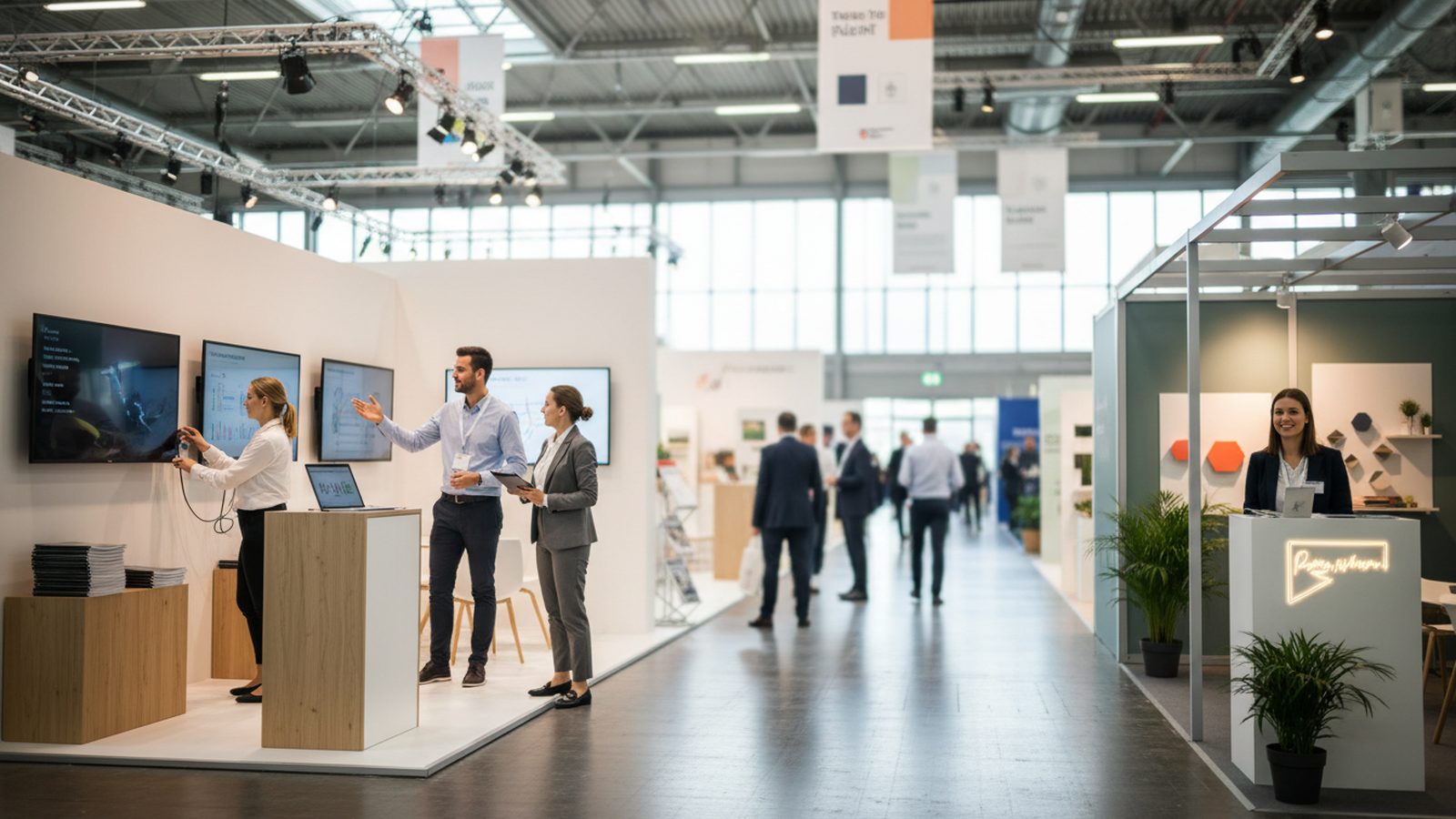
Visitors talk to people, not to back walls. Plan at least two people on the stand at any time, so someone is always available, even during a long conversation. For a full show day you need shifts, so nobody stands for eight hours straight.
Brief the team before the show on dress, greeting visitors and working with the photographer. A simple rule set: no eating and no phones at the stand edge, nobody sits with their back to the aisle.
The real value of a trade fair appears in the weeks afterwards. Decide beforehand how contacts are captured: the organiser's lead app, your own CRM on a tablet, or a paper form. The tool matters less than making sure every contact has three notes: who, what they asked, and what happens next.
Plan the follow-up concretely: who writes to whom, by when? A personal message within a few days, ideally with a photo from the stand or a short clip, is remembered far better than a standard email weeks later. If your sales team is based in another time zone, agree who handles European leads while the show is still fresh. When you scan business cards or store conversation notes, follow data protection requirements; in the EU that means GDPR, so ask your legal adviser if in doubt.
Many first-time exhibitors only realise after the show that they have no usable pictures. Phone photos in hall light, the stand full of boxes, nobody from the team in the frame. Yet a first trade fair is often the moment a young company, or a company new to Europe, becomes visible for the first time: on the website, on LinkedIn, in decks for investors and distributors back home.
Treat photo and video as part of the stand budget. For a first show, two to four hours on the first day are often enough: stand photos before doors open, conversation photos, product details, a team photo and a short highlight clip. Pixer's Basic package costs €990 for two hours, with delivery within 24 hours after the event ends and unlimited usage rights. Companies from outside the EU are invoiced without German VAT, EU companies under reverse charge with a VAT ID. Details on Trade fair photographer Germany.
The most common first-time mistakes: too many messages on the back wall, too few people at peak times, no rule for follow-up, and no pictures that prove you were there. Deadlines for registration, stand construction and services are in the organiser's exhibitor manual, so keep it close. A complete list is in the trade fair checklist for exhibitors.
Leads, distributors, launch, recruiting or press: one clear goal shapes stand, team and material.
A tidy row or corner stand with one message beats a lot of empty floor space.
Someone always available, technical and commercial questions covered, shifts planned.
Who, what they asked, what happens next: three notes per contact.
Professional photos and a short clip keep your first show visible long after it ends.
Deadlines, access times and rules are there, not in rules of thumb.
For large fairs, planning often starts many months ahead because space is allocated early. The organiser publishes the actual registration deadlines on the fair website or in the exhibitor manual. Add time for visas if your team needs them.
Usually a row or corner stand. It keeps planning and budget manageable and works well with one clear message. A tidy, well-lit stand matters more than size.
At least two at any time, so someone is always available. For several show days, plan shifts so the team stays attentive until the end.
Especially then. A first show often produces the first professional pictures for website, LinkedIn and decks. Two hours on the first day cover the essential shots.
Pixer invoices companies from outside the EU without German VAT. EU companies are invoiced under reverse charge with a valid VAT ID.
Planning your first trade fair? Tell us the fair, dates and stand size, and we will tell you which package fits.
We reply within 24 hours. During a show week, WhatsApp is fastest.