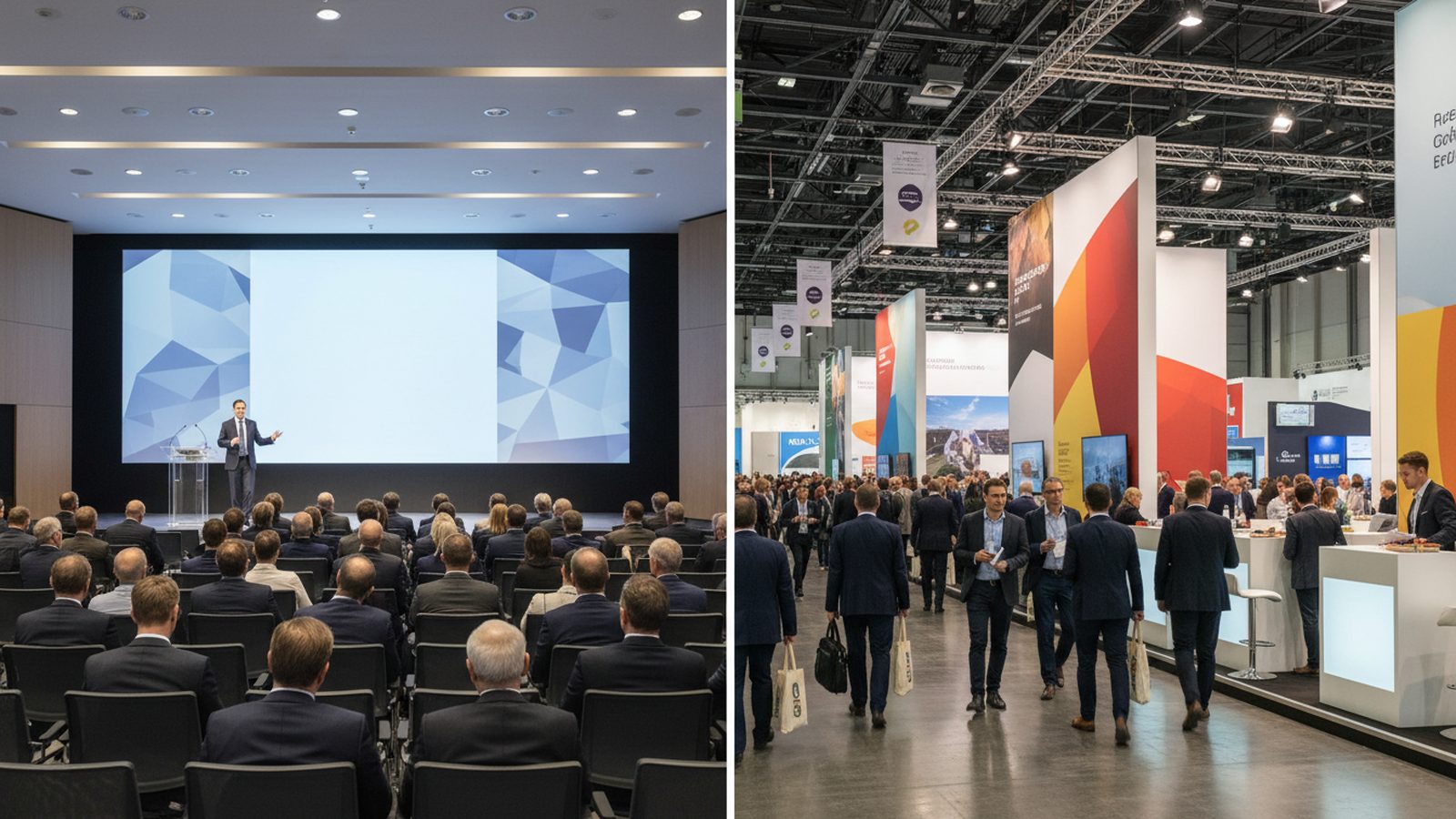
At a conference, the stage tells the story. At a trade fair, the stand does. That changes the shots, the schedule, the sound, the equipment and the formats you need at the end. This comparison helps you brief both, even when your event combines them.
All prices plus VAT · delivered within 24 hours · See all packages & details
A conference follows the programme. There is an agenda with fixed times, a stage, speakers, a seated audience and breaks for networking. The story happens at the front, at minutes you can plan precisely.
A trade fair follows the flow of visitors. Your stand (booth) is open for days, many conversations run in parallel, and the important moments are rarely announced: a customer trying out a machine, a distributor negotiating at the counter. The story is made of encounters, spread across the whole day.
Many events combine both. Congresses come with an exhibition, trade fairs with a stage programme. That makes it all the more important to separate the two in your brief: which part follows the agenda, and which follows the stand? For exhibitors with their own talk on a trade fair stage, that means two shooting plans on one day.
The differences start with the shots themselves:
| Conference | Trade fair | |
|---|---|---|
| Main subject | Speakers on stage, from several angles | Stand, conversations, products, team |
| Timing | by the agenda, to the minute | by visitor flow: quieter in the morning, busy at midday |
| Light | bright stage, dark auditorium | mixed hall light, screens, stand lighting |
| Discretion | quiet camera, usually no flash during talks | unobtrusive, without interrupting sales conversations |
| Other shots | audience, panels, networking, sponsor wall | empty stand, logo from the aisle, product details |
At conferences, the breaks are the time for people shots: conversations at the coffee tables, speakers talking to the audience, your team with customers. If you only photograph the stage, you end up with many similar images of people at a lectern.
For a conference, the photographer needs the agenda with exact times and a list of key speakers, ideally with photos. For a trade fair, they need the stand number, opening hours, a shot list and the people who will be on the stand. More on the trade fair side in our guide to the shots an exhibitor really needs.
At conferences, the job is often a complete recording. Each talk should be available later as its own video, plus highlight edits to promote next year's edition. That requires fixed camera positions, several cameras running at once and sound taken directly from the mixing desk of the stage crew. Coordination with the AV provider on site belongs early in the plan. Also ask whether the organiser records the talks anyway and whether you may use those recordings, before you plan a multi-camera production of your own. Setups and edit versions are covered in our guide to multi-camera conference recording.
At a trade fair, filming is mobile, handheld or on a gimbal, with a clip-on microphone for interviews and ambient sound from the hall. The formats are short: a 30-second highlight video, a 90-second film with interviews, vertical clips in 9:16. Nobody wants to watch the whole show day later, but everyone wants the thirty seconds that show what it was like on your stand.
Conferences add points to the brief that hardly matter at a trade fair:
At a trade fair, other questions come first: which exhibits are confidential, which customers do not want to be recognisable, when are the key appointments on the stand? Both can live in one document, as long as it has clearly separate sections.
A typical planning mistake at combined events: one person is supposed to cover the talk in the auditorium and the stand in the hall at the same time. That only works if the times do not overlap. So fix in your schedule who is where and when. Our guide to the photo and video schedule for show day helps with that.
The equipment differs as well. In the auditorium, fast lenses, tripods and a clean audio connection to the stage matter. On the stand, mobility, a small light for interviews and short distances between shots matter.
At Pixer, two to three people are on site. One can record the talk on stage while a second photographs the stand and films clips. For a full multi-camera recording with sound from the mixing desk, we agree the setup with the stage crew beforehand.
After the event, the requirements differ too. Conference material has a long life: recordings for the on-demand library, speaker photos for the speakers themselves, highlight clips to drive registrations for the next edition. Trade fair material above all has to be fast: posts on the show day, follow-up emails in the week after, images for sales while contacts still remember your stand.
With our trade fair packages, we deliver within 24 hours after the show ends. For long recordings of several talks, agree the delivery date in advance, depending on the number of talks and the edit versions you need.
Think of the speakers too. They like to share good photos of their talk on their own channels, and your event is mentioned along with them. Agree beforehand that they may use the images with credit to your company.
At a conference the stage tells the story, at a trade fair the stand does.
Conferences need times to the minute, trade fairs follow the visitor flow.
Full recordings need the audio feed from the stage crew.
Recordings and highlights at conferences, 30 seconds, 90 seconds and 9:16 at trade fairs.
Get consent for recording and publication early.
If talk and stand overlap, you need more than one person.
Only one after the other. If a talk overlaps with key appointments on the stand, plan two people, one in the auditorium and one on the stand.
For complete recordings, yes, with a wide shot, a close-up and sound from the mixing desk. For short highlight clips, one mobile camera can be enough.
Usually not, because it disturbs speakers and audience. With fast lenses, photos in a dark auditorium work without flash. Still, check the rules with the organiser.
Only with their consent and within the organiser's rules. Get written agreement to the recording and the planned use.
It depends on your goal. Conferences produce long content with expert knowledge, trade fairs many short shots with people and products. For social media, trade fair material is usually more versatile; for your website, a recorded talk often works better.
One document is enough if it has two clearly separate sections: agenda, speakers and times for the stage; stand number, shot list and appointments for the stand. What matters is one shared schedule, so nothing overlaps.
Does your event combine a stage and a stand? Send us the agenda and your stand details, and we will plan who photographs and films where and when.
We reply within 24 hours. During a show week, WhatsApp is fastest.