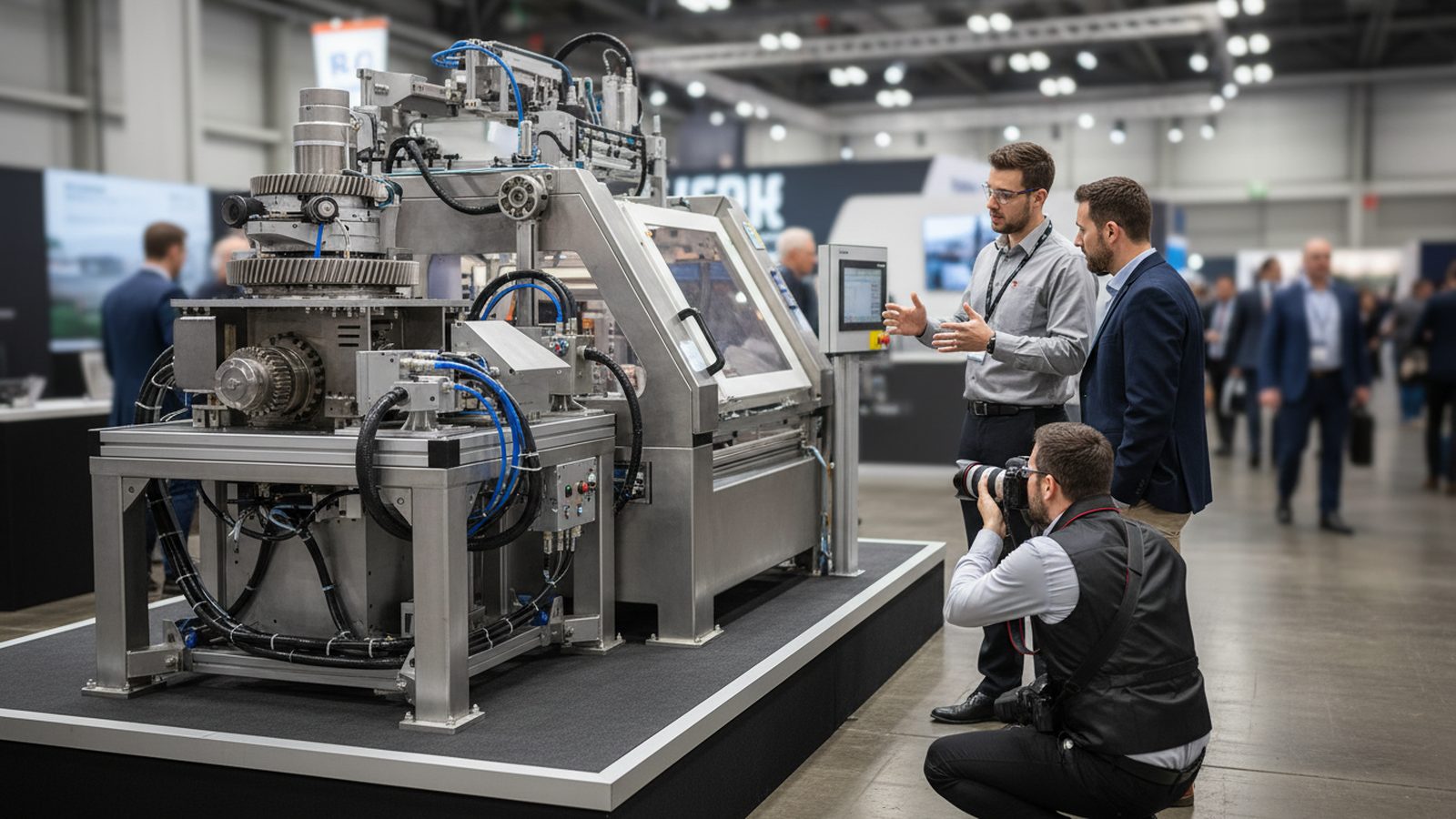
A machine is often the most expensive exhibit a company ever ships to a trade fair. That makes it all the more frustrating when photos show it small, full of reflections or lost among cables. Here is how to get images that show size, engineering and benefit.
All prices plus VAT · delivered within 24 hours · See all packages & details
Machines and production lines ask for a different approach than consumer goods or services. The usual difficulties are:
None of this is a reason to settle for weak images. It simply calls for different planning than a stand with brochures and a counter.
For sales, your website and social media, a fixed shot list works well. Agree it with your photographer before the show:
Photos of parts produced live at the show are worth adding too. They show the result, not just the technology. For product details, read product photos on the stand.
Most problems do not happen while shooting but in the hours before. These points should be done before the first frame:
Before every industrial show we ask for one contact from your technical team who knows the demo times and can clear safety zones. It saves a lot of time on the day, especially when your engineers have flown in from abroad and are busy with visitors from the first hour.
Machine photos work best in three phases:
At large industrial shows such as Hannover Messe or EuroBLECH the halls get very crowded at peak times. The full view before opening is often the only chance of a clear shot.
Machine photos from a trade fair have one advantage over studio shots: they show the equipment at work and in conversation with real prospects. That makes them particularly useful for sales. These uses work well:
Decide before the show who sorts the images after delivery and sends them to sales and partners. Otherwise they sit unused in a folder weeks later.
Few exhibits suit video as well as a running machine. Movement, precision and result can be shown in a few seconds. For a 30-second highlight video, three elements are often enough: the machine in action, a detail of the result and people on your stand (booth). A 90-second film adds a short interview with an engineer who explains in two or three sentences which problem the machine solves.
Machine sound is part of the story, but it should not bury the interview. We record interviews with lavalier microphones, ideally in a pause between two demonstrations. Pixer's Full Day package at €1,990 includes photos, a 30-second and a 90-second film and interviews, delivered within 24 hours after the show ends. Non-EU companies are invoiced without German VAT.
Full view, scale, details, operation, people and machine, audience.
Protective film off, fingerprints gone, cables tidy before the first shot.
Full views on the build-up day or before opening, while the hall is empty.
With the demo times, the photographer is in the right place for every run.
Agree safety zones and protective equipment with your technical team.
A running machine shows in seconds what photos can only suggest.
Put a person in the frame, for example a technician beside or at the machine. Without a reference, size is almost impossible to judge.
On the build-up day after final assembly, or on the show morning before opening. Check service provider access times in the exhibitor manual.
Only as close as your safety officer allows. Demo rules are in the organiser's exhibitor manual. Strong images can also be taken with a telephoto lens from outside the barrier.
With a different camera angle, targeted light and clean surfaces. Raise reflections during build-up, when spots can still be moved easily.
For application images and social media, yes. For cut-out catalogue shots on a neutral background, a studio or a quiet moment on the build-up day works better.
Yes. With Pixer you receive unlimited usage rights to all delivered photos and video.
Showing a machine or production line? Send us the show, hall and demo schedule, and we will plan the shoot around your demonstrations.
We reply within 24 hours. During a show week, WhatsApp is fastest.