At a trade fair, contacts arrive in quick succession: business cards, scanned badges, forms, phone photos. This guide explains in plain language how to capture and follow up leads under the GDPR and keep them out of your show photos. Practical guidance, not legal advice.
All prices plus VAT · delivered within 24 hours · See all packages & details
A business card holds a person's name, job title, company, phone number and email address. Even though these are business details, the GDPR treats them as personal data. As soon as you collect, store and use them, data protection rules apply, at the fair just as in the office.
The aim is not to collect fewer contacts. It is to be able to answer three questions clearly:
Settling these questions before the show saves uncertainty in sales and questions from your data protection officer afterwards. This guide is practical guidance, not legal advice. For binding answers, ask your data protection officer or a lawyer.
Someone who hands you a business card during a conversation usually wants to hear from you about that conversation. Companies therefore typically base the follow-up on both sides' interest in the enquiry or on steps towards a contract. The line is drawn at advertising:
| After the show | Usual practice |
|---|---|
| Personal email with the offer you discussed | Refers to the conversation, generally fine |
| Call back as agreed | Common when linked to the conversation; note the agreement |
| Adding the contact to your newsletter | Only with explicit consent, in Germany usually confirmed by double opt-in |
| General marketing emails unrelated to the conversation | Generally not allowed without consent |
German competition law generally requires prior explicit consent for advertising by email. A business card is not that consent. This can differ from what is common in your home market, so brief your sales team accordingly. If you want visitors for your newsletter, ask them explicitly on the stand, for example with a separate box on the lead form.
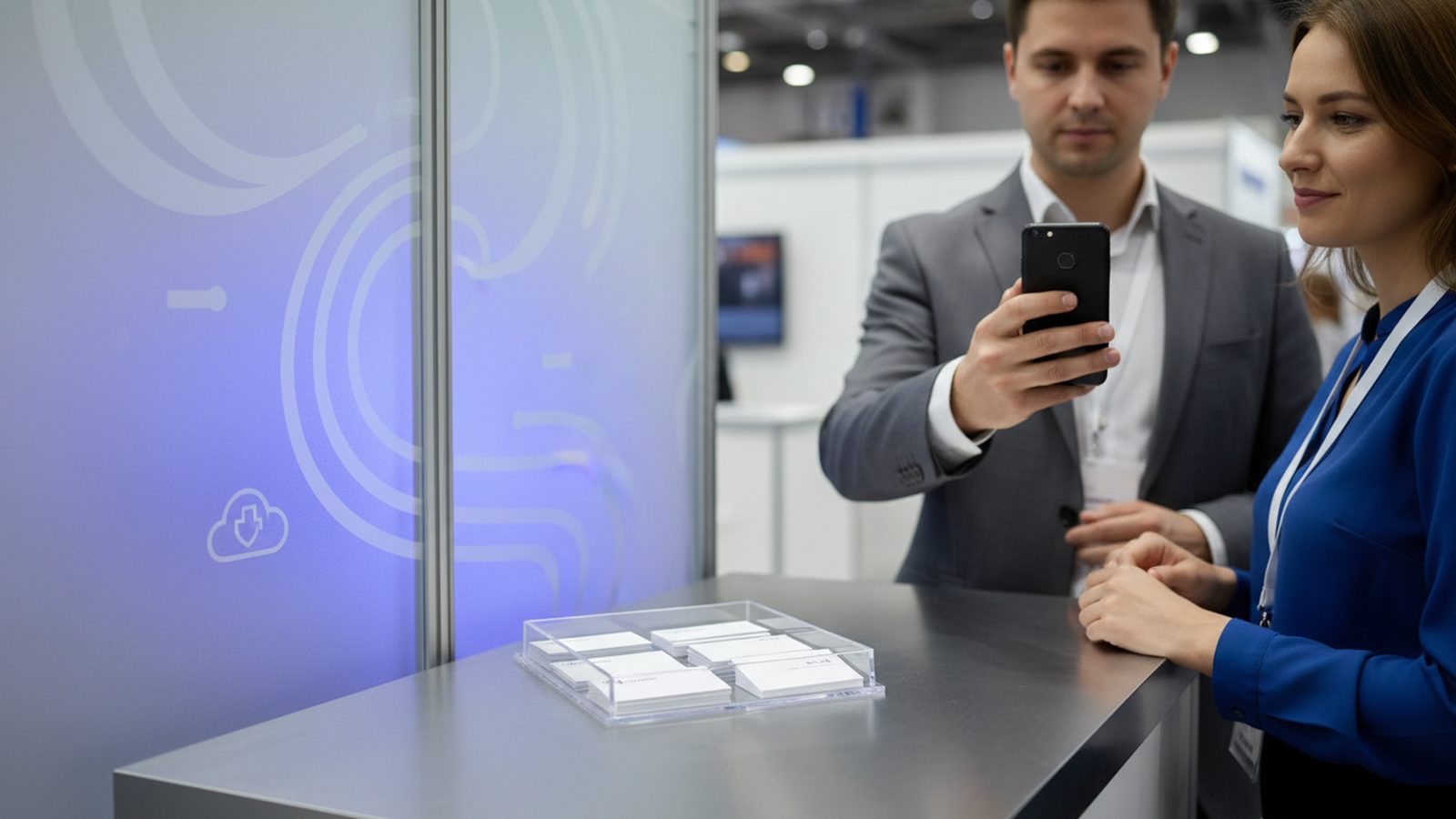
The fastest way to capture a card is often a photo. That is exactly where typical gaps appear:
On paper or on a tablet, a good lead form is short. It asks for what you need for the follow-up and nothing more:
Paper forms are shredded once the data is in the CRM, not packed away with the stand material. Also decide how long you keep leads who never responded, and delete them afterwards. How to get your stand team to follow these routines is covered in our guide to briefing stand staff.
A stack of business cards on the table, a tablet showing the lead list, a whiteboard with the meeting schedule: on LinkedIn, these look like proof of a successful show. If names, email addresses or phone numbers are readable, you are publishing other people's personal data.
When photographing and selecting images, watch for:
When we select show photos for delivery at Pixer, readable cards, lists and screens on your stand (booth) are among the things we check. What else applies to visitors in the picture is explained in our guide to image rights at trade fairs.
One more point for exhibitors from outside the EU: work on the assumption that the GDPR applies to data you collect at a fair in the EU, even if your company is based elsewhere. If leads are transferred to head office outside the EU, that transfer needs a legal basis, such as the EU standard contractual clauses. Discuss this with your data protection officer before the show. This text does not replace legal advice.
Personal data, even as a business contact. It supports a follow-up on the conversation, not a newsletter.
Need explicit consent. A separate box on the form, then double opt-in.
Company device or approved app, deleted after transfer. No private chat groups.
Ask only for what you need. A short notice plus a link to your privacy policy.
No readable cards, lists, screens or schedules in published images.
Set a period for leads who never respond, and stick to it.
A personal message that refers to your conversation is common practice. For newsletters and general marketing emails, you need explicit consent.
Yes, if the data route is clear: company device or approved app, no automatic backup to private clouds, deletion once the data is in the CRM.
Once it is handed over, generally you as the exhibitor. What visitors accepted at registration is in the organiser's terms. Plan your follow-up accordingly.
Anyone collecting personal data has to inform the people concerned. A short notice on the lead form or on the stand with a link or QR code to your full privacy policy is a practical solution.
Replace them with cropped or blurred versions and check with your data protection officer whether further steps are needed. In future, put the point in your photographer's briefing.
Assume it does when you collect data at a fair in the EU. Transferring the leads to your head office needs an additional legal basis. Clarify this before the show.
Planning photos and video for your next show? Tell us the fair and the dates, and we will agree in the briefing what may be readable in the picture and what may not.
We reply within 24 hours. During a show week, WhatsApp is fastest.